
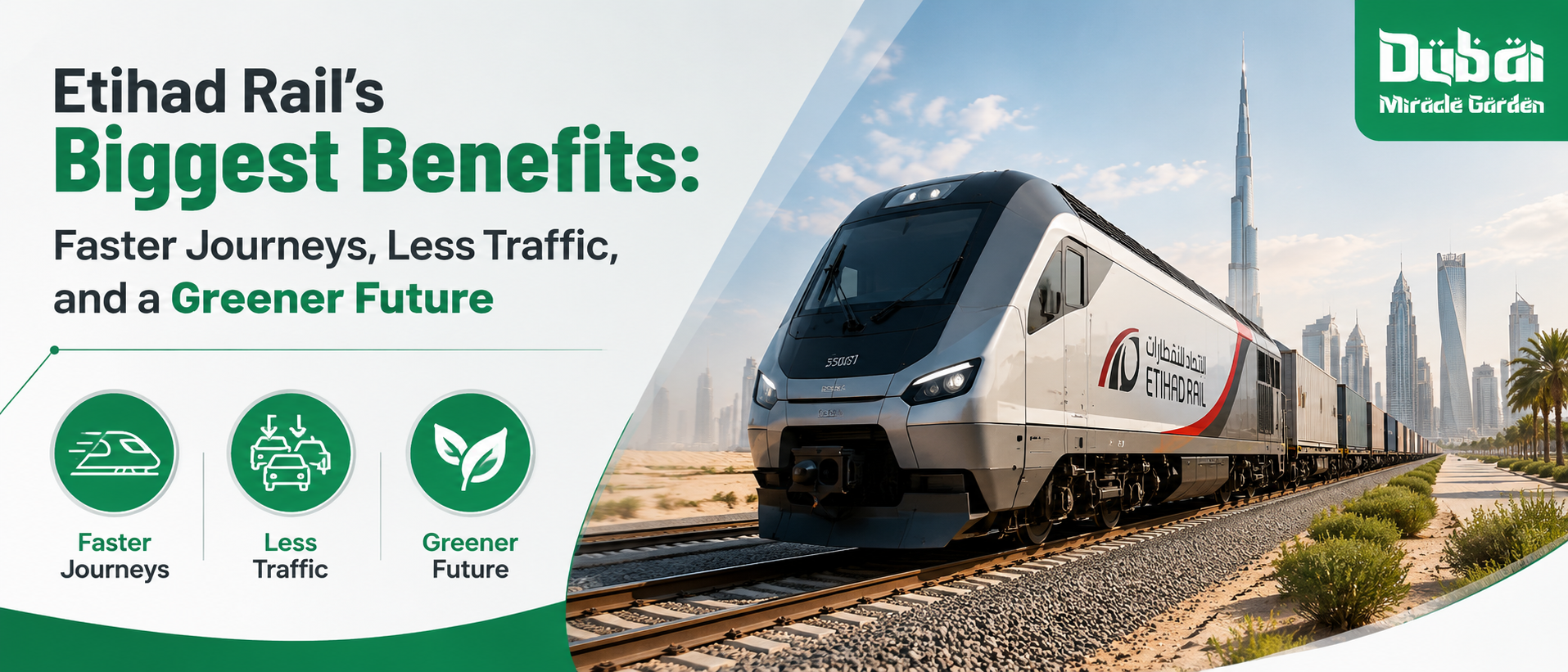
Etihad Rail's Biggest Benefits: Faster Journeys, Less Traffic, And A Greener Future
Introduction
The UAE has long been celebrated for its bold ambitions, futuristic skylines, and world-class infrastructure. Now, the country is writing a defining new chapter in its transport story with Etihad Rail — the national railway network that promises to change how millions of people move across the Emirates. Whether you are a resident tired of gridlocked highways, a tourist eager to explore multiple cities in a single day, or a business traveller looking for a smarter way to connect, Etihad Rail is built for you. With the much-anticipated Etihad Rail passenger service launch now confirmed, it is time to understand exactly why this project is so transformative, what it offers, and what you need to know before you board.
What Is Etihad Rail and Why Does It Matter?
Etihad Rail is the UAE's national railway developer and operator, established in 2009 under Federal Law No. 2. For years, it has been quietly operating freight trains across the country, but its passenger ambitions are far grander in scale. Spanning approximately 900 kilometres, the network is being built to connect 11 cities and regions across all seven emirates — from Al Sila in the far west to Fujairah on the east coast, passing through major urban centres like Abu Dhabi, Dubai, and Sharjah.
This is not simply a train project. It is the backbone of a new national mobility ecosystem that integrates rail, road, and last-mile transport into one connected experience. For travellers visiting the UAE from around the world, it means the freedom to explore the country's diverse landscapes, cultural hubs, and commercial centres without ever sitting in traffic.
The Etihad Rail Passenger Service Launch: Dates You Need to Know
One of the most frequently searched questions about this project has been: when will Etihad Rail open for passengers? The answer is now clear and confirmed.
Etihad Rail's introductory operational phase begins on 30 June 2026, with services running between Abu Dhabi's Mohamed bin Zayed City Passenger Train Station and Fujairah's Al Hilal City station. This marks the Etihad Rail opening that the UAE has been building toward for over a decade.
The rollout then expands in carefully planned phases:
The Dubai Train Station at Jumeirah Golf Estates and Al Dhaid Train Station in Sharjah open on 30 September 2026, representing the full public launch of the network. Stations across the Al Dhafra region follow on 30 December 2026. The complete network, including Sharjah's final station, reaches full operation on 30 March 2027.
So to directly answer another common question — at which date does the Etihad Rail passenger train start? — passenger services officially begin on 30 June 2026, with the full UAE-wide network operational by early 2027.
Ticket bookings opened on 23 June 2026 through the official Etihad Rail mobile application and website. Stations operate daily from 5am to 11pm, and at launch, three direct daily services run in each direction on the inaugural route.
Etihad Rail Stations: A Network Built Around You
The Etihad Rail stations are designed to be far more than simple boarding points. Officials have described them as lifestyle hubs — destinations in themselves, featuring cafés, restaurants, retail outlets, and international brands. The Mohamed bin Zayed City Passenger Train Station in Abu Dhabi was the first to be inaugurated, setting the tone for the quality of infrastructure passengers can expect across the network.
Here is the confirmed list of Etihad Rail stations that will form the complete passenger network once fully built out:
Abu Dhabi (Mohamed bin Zayed City), Dubai (Jumeirah Golf Estates), Sharjah, Fujairah (Al Hilal City), Al Dhaid, Al Dhannah, Al Faya, Madinat Zayed, Mezaira'a, Al Mirfa, and Al Sila.
For travellers exploring the UAE, these Etihad Rail stations in Dubai and Abu Dhabi will act as natural starting and ending points for multi-city adventures. Dubai's RTA has already confirmed it is ramping up feeder bus and taxi connections at the main station to make last-mile travel seamless. There are also strong indications that Al Maktoum International Airport will eventually have its own Etihad Rail station once the airport's major expansion is complete — a significant development for international tourists arriving into the new facility.
The Etihad Rail Route: Connecting the UAE Like Never Before
The full Etihad Rail route stretches from Al Sila on the western edge of Abu Dhabi emirate all the way east to Fujairah, cutting through the heart of the country. The route is a 900-kilometre arc that links ports, industrial zones, urban centres, and tourism destinations in one continuous corridor.
For travellers, the Etihad Rail route opens up itinerary possibilities that simply were not practical before. Imagine starting your morning in Abu Dhabi, arriving in Dubai in under an hour, and continuing to Fujairah's beaches by lunchtime — all without renting a car or sitting in highway traffic. That is exactly the kind of flexibility this network was designed to enable.
The route also connects with the wider GCC Railway vision, with Stage Two of Etihad Rail planned to reach the Saudi Arabian border. Future extensions via the Hafeet Rail project — a joint venture with Oman Rail — will eventually link the network all the way to Sohar Port in Oman, making cross-border rail travel a reality for the region.
Etihad Rail Abu Dhabi to Dubai: The Journey That Changes Everything
Of all the connections on the network, perhaps none is more anticipated than the Etihad Rail Abu Dhabi to Dubai link. Currently, the drive between the two cities can take anywhere from 60 minutes on a good day to well over two hours during peak traffic. The train changes that completely.
Etihad Rail will connect Abu Dhabi and Dubai in just 57 minutes at a maximum speed of 200 km/h. This alone represents a travel time reduction of 30 to 40 percent compared to road travel. For daily commuters, weekend visitors, and business travellers making the round trip between the UAE's two largest cities, this is genuinely life-changing.
Looking further ahead, the picture becomes even more impressive. In 2025, Etihad Rail announced plans for a dedicated high-speed rail line between Abu Dhabi and Dubai — a separate 150-kilometre corridor that will cover the distance in just 30 minutes at speeds of up to 350 km/h. This ultra-high-speed connection is expected to be operational by 2030, cementing the UAE's place among the world's most advanced rail nations.
Etihad Rail Abu Dhabi to Dubai Ticket Price: What Will It Cost?
Pricing is naturally one of the most searched topics around this project. While the complete fare schedule for all Etihad Rail routes is still being rolled out, the etihad rail abu dhabi to dubai ticket price has not yet been fully disclosed. However, here is what has been officially confirmed so far.
For the introductory Abu Dhabi to Fujairah route — currently the only published fare — tickets start at AED 55 for Comfort Class and AED 120 for Premium Class. These prices reflect a 50 percent introductory launch discount applied at opening, with original fares standing at AED 109 for Comfort Class and AED 239 for Premium Class.
Given the Abu Dhabi to Dubai journey is shorter in distance (around 57 minutes versus 1 hour 45 minutes for Fujairah), fares on that route are expected to be comparably accessible once announced. Dubai's RTA is the official ticketing and payment partner for Etihad Rail, and there are strong indications that Dubai's popular Nol card may be integrated as one of the payment options — a major convenience for existing metro and bus users in the city.
Passengers can book and purchase tickets through the Etihad Rail mobile application and official website, both of which became live on 23 June 2026.
Etihad Rail Passenger Train Timings and Onboard Experience
Three direct daily services run in each direction on the inaugural Abu Dhabi–Fujairah route. Stations operate from 5am to 11pm daily, giving passengers flexibility to travel at times that suit their schedule.
When it comes to the etihad rail passenger train timings and the onboard experience, this is where the project really sets itself apart from regional expectations. The fleet consists of 13 high-technology trains, each designed to carry up to 400 passengers across three travel classes — Economy, Family, and First Class. A business class carriage offers 16 seats in a more intimate setting, while economy carriages seat 56 passengers each.
Onboard, passengers can expect free Wi-Fi, infotainment systems, personal charging stations, air conditioning calibrated for the Gulf climate, and food and beverage services. Etihad Rail has signed a contract with Arsenale, an Italian luxury hospitality company, to lead the onboard experience design — an approach that evokes the elegant styling of the Orient Express for the modern age. In other words, the journey itself is meant to be part of the pleasure.
Passenger services are operated by Etihad Rail Passenger Services, a joint venture between Etihad Rail and Keolis — one of the world's most experienced passenger transport operators — bringing international safety standards and railway expertise directly to the UAE's national network.
Faster Journeys Across the UAE: Journey Times at a Glance
One of the most compelling arguments for choosing Etihad Rail over road travel is the sheer time saved on every journey. Here is what the official timings look like once the full network is operational:
Abu Dhabi to Dubai: 57 minutes. Abu Dhabi to Fujairah: 1 hour 45 minutes. Abu Dhabi to Al Ruwais: 1 hour 10 minutes. Dubai to Fujairah: 1 hour 9 minutes.
These journey times represent a consistent 30 to 40 percent reduction compared to travelling by car under normal conditions — and a far greater saving during rush hours or peak holiday periods when UAE highways are at their most congested. By 2030, the network aims to transport 36.5 million passengers annually, making it one of the most-used rail systems in the region.
Less Traffic on UAE Roads: The Bigger Picture
For anyone who drives in the UAE regularly, the promise of reduced congestion is just as exciting as the speed of the trains themselves. The Sheikh Zayed Road corridor between Abu Dhabi and Dubai is consistently rated among the most congested stretches of highway in the Gulf region. Etihad Rail directly addresses this.
By shifting large numbers of commuters and travellers from private cars to rail, the network is expected to remove significant volumes of vehicles from UAE roads every single day. Etihad Rail projects that the rail network will result in 670 fewer road crashes and 52 fewer fatalities over the long term as a direct result of reduced road traffic. For a country that has invested substantially in road safety initiatives, this statistic speaks to the project's genuine impact on everyday life — not just travel convenience.
Beyond passenger vehicles, the freight component of Etihad Rail is already operational with a fleet of 38 locomotives and over 1,000 wagons, moving goods that would otherwise require dozens of heavy trucks on the nation's highways every day. The combination of freight and passenger rail together represents a fundamental shift in how the UAE moves people and goods.
A Greener Future: Etihad Rail and the UAE's Environmental Commitments
The sustainability story behind Etihad Rail is one of the most underreported aspects of this project — and one of its most important. The UAE has made firm commitments to its Net Zero 2050 Strategy, and Etihad Rail sits squarely at the centre of that ambition.
Based on traffic volume forecasts, the Etihad Rail network will reduce greenhouse gas emissions by more than 2.2 million tonnes annually. To put that in perspective, this is the equivalent of removing up to 375,000 vehicles from UAE roads every single year. The estimated total benefit of emissions savings — accounting for both freight and passengers shifting from road to rail — is approximately AED 24 billion over the next 50 years.
Rail travel is inherently more energy-efficient per passenger kilometre than private car journeys or short-haul flights between emirates. As the UAE works to diversify away from fossil fuel dependence and meet its climate targets, building a national rail network is one of the most structurally impactful investments the country can make.
For international visitors who are increasingly making sustainability a factor in how they choose to travel, Etihad Rail offers a way to explore the UAE that aligns with those values — experiencing the country's incredible diversity while leaving a lighter footprint.
Why This Matters for Tourists and Global Travellers
For tourists arriving in the UAE, Etihad Rail opens up the country in an entirely new way. Previously, exploring multiple emirates in a single trip required either renting a car, booking expensive taxis, or joining organised tours. The train changes that entirely.
A visitor landing in Dubai can board a train to Abu Dhabi for a day trip to the Louvre Abu Dhabi or the Sheikh Zayed Grand Mosque, then return in the evening comfortably. Alternatively, a traveller staying in Abu Dhabi can hop on the train to reach Fujairah's pristine beaches and snorkelling spots without the stress of unfamiliar road driving. The Etihad Rail route essentially unlocks the full width of the UAE for independent travellers in a way that was not possible before.
The station experience itself will add to this appeal. Designed as lifestyle destinations with premium dining, retail, and hospitality offerings, the etihad rail stations in Dubai and Abu Dhabi will give travellers a welcoming and modern gateway into each emirate.
Connecting the UAE to the Region and the World
Etihad Rail is not just a domestic project. It is a cornerstone of the Gulf Cooperation Council Railway vision — an ambitious regional network that ultimately aims to connect all six GCC member states by rail. The UAE's network is designed to link at the Saudi Arabian border, eventually forming part of a corridor that runs from Kuwait to Oman.
The Hafeet Rail project — connecting Abu Dhabi to Sohar Port in Oman via Al Ain, with construction underway since May 2024 — is the first cross-border extension of this vision. For businesses, this creates powerful logistics possibilities. For tourists, it hints at a future where you could board a train in Dubai and arrive in Riyadh or Muscat without stepping on a plane.
A Milestone Built on Vision and Momentum
The etihad rail opening in June 2026 is the result of a journey that began when Etihad Rail was first established in 2009. Stage One freight operations began in January 2016, on time and within budget. Stage Two extended the network to 900 kilometres and commenced operations in February 2023. The passenger service, announced as part of the UAE's Projects of the 50 initiative in 2021, has now arrived ahead of the broader 2027 target for full network completion.
The partnership with Keolis for passenger operations, the Italian luxury design approach to the onboard experience, and the integration with Dubai's RTA for ticketing all reflect the level of international collaboration going into every aspect of this project. This is a railway built not just to move people but to represent the UAE's identity as a global leader in innovation, connectivity, and sustainable development.
Final Thoughts: Etihad Rail Is the Future of UAE Travel
Etihad Rail is arriving at exactly the right moment. The UAE's population and tourism numbers continue to grow. Road infrastructure, as well-built as it is, faces increasing pressure. The demand for sustainable, efficient, and premium transport solutions has never been higher — from residents, from businesses, and from the millions of international visitors who choose the UAE as their destination each year.
With the Etihad Rail passenger service launch confirmed for 30 June 2026, faster journeys between emirates are no longer a promise — they are a scheduled reality. The etihad rail route connecting Abu Dhabi, Dubai, Sharjah, Fujairah, and beyond will reduce commute times, ease congestion on highways, cut carbon emissions by millions of tonnes, and deliver a travel experience worthy of the UAE's global reputation.
Whether you are asking when will Etihad Rail open for passengers, searching for the etihad rail abu dhabi to dubai ticket price, or simply planning your next adventure across this remarkable country, the answer is the same: the train is coming, and it is worth every bit of the wait. Book your tickets through the Etihad Rail app or website, and get ready to experience the UAE at speed, in style, and with a clear conscience about the journey you are making — for yourself and for the planet.