Difference Between Hajj And Umrah: Everything Muslims Need To Know
Introduction
When I came back from my Hajj journey, almost every second person asked me the same question: "So is Umrah the same as Hajj, just smaller?" I used to think the same thing before I went. But once you stand in Ihram on the plains of Arafat, or walk between Safa and Marwa during Umrah, you realize these two acts of worship feel and work very differently.
In this guide, I'm sharing everything I learned — as a Muslim who has personally performed Hajj — about the difference between Hajj and Umrah, the rituals involved, the cost, the best time to go, and the latest updates from the Ministry of Hajj and Umrah. I've kept the language simple, added tables and bullet points so you can scan it quickly, and double-checked every fact before writing it down.
What Is Hajj in Islam?
Here’s what you need to know before we discuss the differences – this is where most get confused.
Hajj is the pilgrimage to Makkah ( Mecca ) that all Muslims who are physically and financially able to do so are required to undertake at least once in their lives . It is only performed during certain days of the Islamic month of Dhul Hijjah and consists of a series of fixed rituals performed in a fixed order - at the Kaaba, Mina, Arafat and Muzdalifah.
The other is known as the “minor pilgrimage,” or umrah. It is easy to do at any time of the year, takes only a few hours to complete and it is not obligatory, but highly recommended (Sunnah) and brings great spiritual reward.
Summary: Hajj is Fard, time bound, and longer. Optional, flexible and shorter, Umrah is. That’s the essence of it - but there’s a lot more detail you may want to know.
What Is Hajj in the Five Pillars of Islam?
A lot of people search for "what is hajj in the five pillars of islam" because they're not sure where it fits. Here's the simple answer, laid out in order:
| Pillar Number | Name | What It Means |
| 1st Pillar of Islam | Shahada | Declaration of faith — belief in One God and Prophet Muhammad (PBUH) as His messenger |
| 2nd Pillar of Islam | Salah | Performing the five daily prayers |
| 3rd Pillar of Islam | Zakat | Giving a fixed portion of wealth to those in need |
| 4th Pillar of Islam | Sawm | Fasting during the month of Ramadan |
| 5th Pillar of Islam | Hajj | The pilgrimage to Makkah, once in a lifetime, if you're able to afford and undertake it |
So to directly answer it: Hajj is the fifth and final pillar of Islam. It's often called the "crown" of worship because it combines elements of all the other pillars — faith, prayer, charity, and self-discipline — into one journey. Umrah is not one of the five pillars; it's a separate, recommended act of worship.
Difference Between Hajj and Umrah: The Core Answer
If you're searching for what is the difference between Hajj and Umrah in one line, here it is:
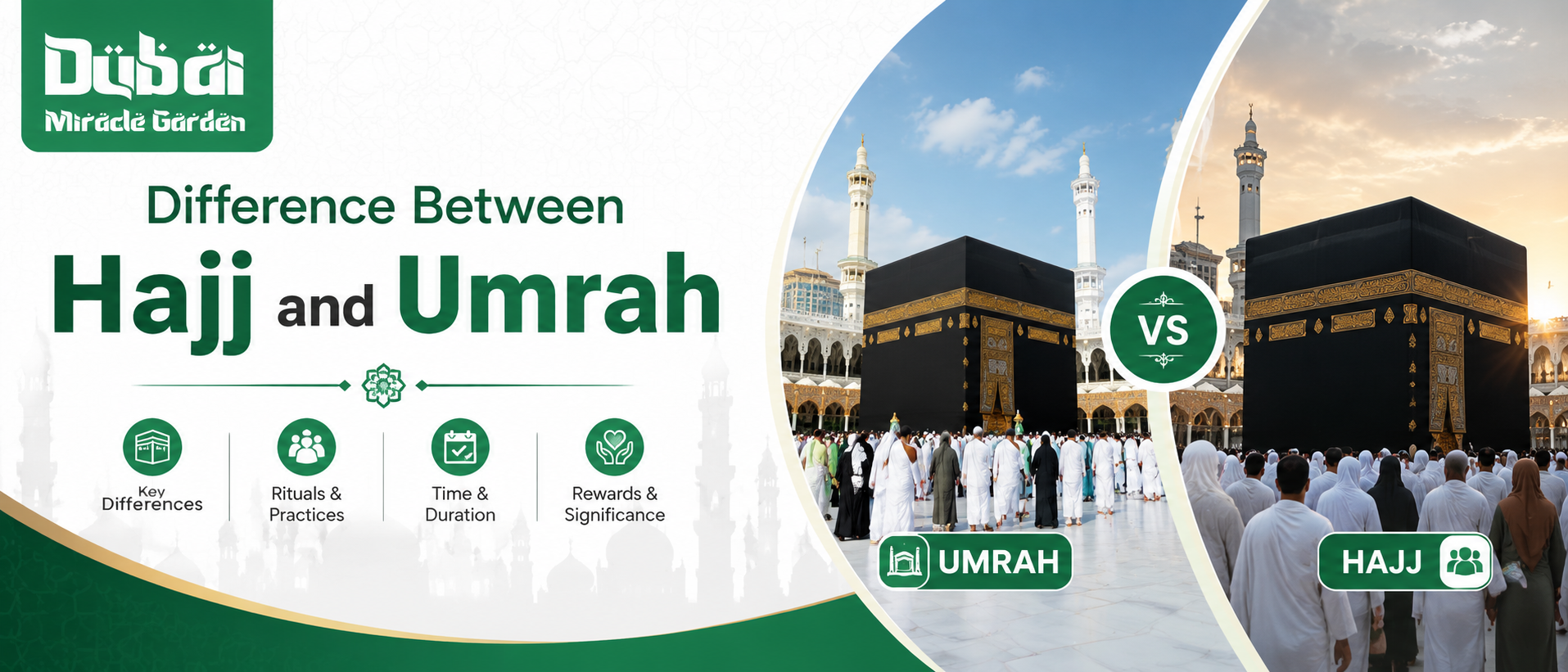
Hajj is a compulsory, once-a-year pilgrimage with a fixed set of rituals tied to specific dates, while Umrah is an optional pilgrimage that can be performed any time of the year with fewer rituals.
But that one-liner doesn't tell the full story. Below is a detailed table covering the 10 differences between Hajj and Umrah that I wish someone had explained to me before my first trip.
10 Differences Between Hajj and Umrah (Table)
| Serial no | Aspect | Hajj | Umrah |
| 1 | Religious status | Obligatory (Fard) for every able Muslim, once in a lifetime | Voluntary (Sunnah), though highly rewarding |
| 2 | Timing | Only during specific days of Dhul Hijjah (8th–12th/13th) | Any time of the year, including during Hajj season |
| 3 | Duration | Usually 5–6 days of rituals, plus travel | Can be completed in a few hours |
| 4 | Place of pillar | One of the five pillars of Islam | Not part of the five pillars |
| 5 | Key locations visited | Makkah, Mina, Arafat, Muzdalifah | Only Makkah (Kaaba and Masjid al-Haram) |
| 6 | Standing at Arafat (Wuquf) | Compulsory — considered the heart of Hajj | Not required |
| 7 | Stoning the Jamarat | Required at Mina | Not part of Umrah |
| 8 | Animal sacrifice (Qurbani) | Required for most pilgrims | Not required |
| 9 | Crowd size | Millions of pilgrims at the same time, every year | Smaller crowds, spread across the whole year |
| 10 | Approximate cost | Higher — due to longer stay, visa, and logistics | Generally lower — shorter trip, fewer services needed |
This table alone answers most of what people ask me, but let's break down the actual rituals too, because that's where the real difference shows up.
Hajj and Umrah Rituals Compared
Some of the rituals in Hajj and Umrah are similar, but Hajj has some additional rituals, which makes it a longer and more strenuous journey.
Common rituals of Hajj and Umrah:
- Enter Ihram (special clothing & intention)
- Tawaf — going around the Kaaba seven times
- Sa'i — walking seven times between the hills of Safa and Marwa
- Cut the hair or shave to mark the end
Hajj-specific rites:
- Overnight in Mina on the 8th of Dhul Hijjah
- On the 9th of Dhul Hijjah, standing at Arafat (the most important day of Hajj)
- Spend the night in Muzdalifah
- Stoning the Jamarat (pillars representing Iblis) over a number of days
- Qurbani (Animal Sacrifice) on Eid al-Adha
- Return to Mina for the days of stoning (Ayyam al-Tashreeq)
What I remember most is the night in Muzdalifah, where thousands of people sleep under the open skies, with nothing but a mat and the stars above them. This is something that Hajj and Umrah don’t have and it is one of the most humbling experiences of the whole journey.
Can You Do Umrah During Hajj?
I get asked this question a lot so let me answer it clearly: yes, you can do umrah during Hajj, in fact many pilgrims do both.
There are three main ways to do Hajj, and this is how Umrah fits in:
- Hajj Tamattu: First do Umrah, come out of Ihram and then go into Ihram for Hajj. This is the most popular type for first time pilgrims.
- Hajj Qiran: You make the intention of both Hajj and Umrah together, and do the rites of Umrah and then the rites of Hajj without removing Ihram in between.
- Hajj Ifrad: You do only hajj and not Umrah, this is usually done by people living near Makkah.
If you choose Hajj Tamattu' or Hajj Qiran, you are technically performing an Umrah as part of your Hajj journey. This is also why some people get confused between the two – because for a large number of pilgrims, the trip literally starts with Umrah rituals before Hajj starts.
Ministry of Hajj and Umrah News: What's New for 2026
The Saudi Ministry of Hajj and Umrah keeps updating its systems every year, and the 2026 (1447 AH) season has brought some important changes that every pilgrim should know:
- Hajj registration for the 1447 AH (2026) season opened through the Nusuk Hajj platform, which is now the only authorised channel for pilgrims applying under the Direct Hajj Program — no agents or middlemen are needed for this step.
- Pilgrims can compare packages directly on the platform, choose their preferred service tier, and pay through an installment-based digital wallet.
- For Umrah, the Ministry announced that visa issuance and pilgrim arrivals for the new Umrah season begin from late May, with permits to enter Makkah managed through the Nusuk app.
- Ahead of the Hajj season, the Ministry temporarily pauses new Umrah visa issuance and tightens entry to Makkah for a few weeks, so anyone planning Umrah close to Hajj season should check the official Nusuk and Ministry of Hajj and Umrah websites for current dates before booking.
My advice: always double-check directly on haj.gov.sa before paying any travel agent, because the rules and dates shift slightly every year based on the Islamic lunar calendar.
Hajj Cost 2026: What Pilgrims Should Expect
One of the biggest questions people ask me is about the Hajj cost 2026, and honestly, the answer depends heavily on which country you're traveling from.
| Region/Country | Approximate Hajj Cost 2026 (Government/Subsidised Packages) |
| USA | Around $8,000 and above for economy packages |
| UK | Around £5,000–£8,000 for economy packages |
| India | Roughly ₹3.5–4.5 lakh (~$4,200–$5,400) through the Hajj Committee |
| Indonesia | Around $3,400 (one of the most subsidised) |
| Pakistan | Roughly PKR 1,065,000–1,075,000 for the government scheme |
A few honest tips from my own experience:
- Government or Hajj Committee packages are almost always cheaper than private operators, but seats fill up fast — apply as early as possible.
- Airfare can make up 30–40% of your total cost, so booking flights early (before the rush months) really helps.
- Always budget extra for daily expenses in Makkah and Madinah — food, local transport, and gifts add up quickly, even with a "fully inclusive" package.
- If your package offers a "non-shifting" stay (you stay in Makkah the whole time instead of moving to Mina-area hotels before/after), it usually costs more, but it's worth it for comfort if your budget allows.
Weather at Mecca: When Should You Go?
The weather at Mecca plays a huge role in how comfortable your trip will be, especially since Hajj dates shift slightly every year based on the lunar calendar.
| Season | Approx. Daytime Temperature | What to Expect |
| Winter (Dec–Feb) | Around 29–31°C | Coolest and most comfortable months to visit |
| Spring (Mar–May) | Around 35–42°C | Getting warmer, still manageable in the mornings |
| Summer (Jun–Aug) | Around 42–44°C | Extremely hot, intense sun — needs serious heat precautions |
| Autumn (Sep–Nov) | Around 33–38°C | Gradually cooling down |
A few practical things I learned the hard way:
- Mecca's climate is desert-like — very dry, with almost no rainfall, and the sun can be brutal even in the shade.
- If your Hajj dates fall in the summer months, carry a small umbrella, a spray bottle for water, and light-coloured, breathable Ihram cloth.
- Hydration is everything. I drank more Zamzam water during Hajj than I have water in months back home — and it helped more than I expected.
- For Umrah, if you have flexibility, the cooler winter months (December to February) are far more comfortable for long hours of walking and standing in worship.
My Personal Experience: A Few Honest Reflections
I won't pretend Hajj was easy. The crowds are massive, the heat is real, and physically it tests you. But there's something about standing at Arafat, surrounded by people from every country, every language, every background — all dressed the same, all asking for the same thing from Allah — that I can't fully put into words.
Umrah, when I did it separately on another trip, felt more personal and quiet in comparison. I had more time to sit in Masjid al-Haram, read the Quran, and just reflect, without the structured schedule that Hajj demands.
If someone is preparing for either journey, my honest advice is:
- Don't over-plan every minute — leave room for spontaneous moments of worship.
- Physical preparation matters — walk more in the months before you go.
- Be patient with crowds; everyone is tired, and kindness goes a long way.
- Keep your intentions sincere — that's really what both Hajj and Umrah are about.
Final Thoughts
Ultimately, the distinction between the two is in the duty, timing and rituals involved but both are extremely significant acts of worship that link a Muslim directly to the history of Prophet Ibrahim (AS) and the legacy of Prophet Muhammad (PBUH). If you’re going for Hajj this year or just a quieter Umrah trip, my biggest advice is still the same: prepare well, stay informed from official sources like the Ministry of Hajj and Umrah and Nusuk, and most importantly, go with sincerity in your heart. And that's something no guide can teach you, you don't know it until you're there standing on your own.